Iptv Streaming
Television viewing in the United Kingdom has changed significantly as internet-based streaming has become increasingly common. Alongside traditional terrestrial, satellite, and cable television, viewers can now access video content through internet-connected televisions, streaming devices, computers, tablets, and smartphones.
IPTV in the United Kingdom is part of this broader transition toward internet-based television. IPTV, or Internet Protocol Television, delivers television and video content over IP networks rather than relying exclusively on conventional broadcasting methods.
For UK viewers, understanding how IPTV works can help them choose suitable equipment, improve streaming performance, and troubleshoot common technical issues.
This guide covers the fundamentals IPTV users in the United Kingdom should know, including internet requirements, compatible devices, streaming quality, Smart TV setup, buffering solutions, security, and content licensing.
What Is IPTV?
IPTV stands for Internet Protocol Television.
It is a technology for delivering television and video content through an Internet Protocol network. Instead of receiving programming through terrestrial broadcast signals, satellite transmission, or cable infrastructure, IPTV uses an IP-based connection to deliver content to compatible devices.
Depending on the service and available rights, IPTV may support:
- Live television
- Video on demand
- Catch-up programming
- Electronic Programme Guides
- Recorded content
- HD streaming
- 4K streaming
- Subtitles and multiple audio tracks
The features available depend on the platform, application, device, content source, and licensing arrangements.
How Does IPTV Work in the UK?
The basic IPTV process involves delivering encoded video data through an IP network to a compatible playback device.
A simplified process looks like this:
Video Content → Encoding → IP Network → IPTV Application → Smart TV or Device → Display
The content is encoded into a format suitable for internet transmission. The viewer’s device receives the data and decodes it for playback.
Several factors influence the final experience, including:
- Internet speed
- Network stability
- Video bitrate
- Resolution
- Device hardware
- Application performance
- Network congestion
- Content delivery infrastructure
This means that IPTV performance cannot be determined by internet speed alone.
IPTV vs Traditional Television
Traditional television can use terrestrial broadcasting, satellite, or cable networks. IPTV uses Internet Protocol networks.
Each method has different characteristics.
Traditional Television
Traditional television may rely on:
- Aerial reception
- Satellite dishes
- Cable connections
- Dedicated broadcast infrastructure
IPTV
IPTV generally requires:
- Internet connectivity
- Compatible hardware
- Compatible software
- Authorized video content
One of IPTV’s major characteristics is its ability to deliver content through internet-connected devices.
What Do You Need for IPTV in the UK?
Setting up IPTV does not necessarily require complicated equipment.
The basic requirements are usually:
Reliable Broadband
A stable broadband connection is essential for internet-based streaming.
Approximate connection requirements can vary by video quality:
| Video Quality | Approximate Recommended Speed |
| SD | 5 Mbps+ |
| HD | 10 Mbps+ |
| Full HD | 20 Mbps+ |
| 4K | 35–50 Mbps+ |
These numbers are general guidelines, not guaranteed requirements. Actual performance depends on video bitrate, compression, network conditions, and simultaneous internet usage.
Compatible Device
Depending on the application and service, IPTV may work on:
- Smart TVs
- Android TV devices
- Google TV devices
- Streaming boxes
- Streaming sticks
- Smartphones
- Tablets
- Computers
Always check compatibility with your particular device before installing an IPTV application.
Compatible IPTV Application
Some IPTV services require a dedicated application or media player.
Applications may provide features such as:
- Live channel playback
- EPG
- Playlists
- Video-on-demand libraries
- Subtitles
- Multiple audio tracks
- Playback controls
Features vary between applications.
IPTV on Smart TVs in the UK
Smart TVs are one of the most convenient ways to access internet-based television.
Depending on the television’s operating system, compatible applications may be available through its official application marketplace.
Popular Smart TV platforms include:
- Android TV
- Google TV
- Samsung Tizen
- LG webOS
Application availability can vary by model and region.
Older Smart TVs may also have limited application compatibility because of outdated operating systems or hardware.
IPTV on Android TV and Google TV
Android-based television platforms offer access to a large range of applications.
The general process is:
- Connect the television to the internet.
- Open the application marketplace.
- Search for a compatible IPTV application.
- Review its requirements.
- Install the application.
- Configure your authorized content source.
- Start streaming.
The exact process can vary according to the application.
IPTV on Samsung Smart TVs
Samsung Smart TVs use the Tizen platform.
If a compatible IPTV application is available for your particular television model and region, it can generally be installed through the official application marketplace.
Before installation, check:
- TV model
- Tizen version
- Application compatibility
- Regional availability
- Required hardware specifications
IPTV on LG Smart TVs
LG Smart TVs use webOS, with features varying between generations.
To use IPTV, users generally need an application that supports their particular webOS version.
If an application is unavailable, a compatible external streaming device may provide an alternative platform.
IPTV on Mobile Devices
IPTV is not limited to televisions.
Depending on application compatibility, users may access internet-based television on:
- Android smartphones
- iPhones
- Android tablets
- iPads
Mobile streaming can be useful when travelling or watching content away from the main television.
Remember that mobile streaming can consume substantial amounts of data, particularly at higher resolutions.
Internet Speed Requirements for IPTV in the United Kingdom
Internet speed is one of the most important factors affecting IPTV performance.
However, stability matters as much as speed.
A connection with a high advertised speed can still experience problems if it has:
- High latency
- Packet loss
- Wi-Fi interference
- Network congestion
- Frequent connection drops
For the best results, test your connection at different times of the day if you experience inconsistent performance.
Wi-Fi vs Ethernet for IPTV
Both Wi-Fi and Ethernet can support IPTV.
Ethernet
A wired Ethernet connection can offer:
- Consistent connectivity
- Lower interference
- Stable bandwidth
- Reliable performance
It is particularly useful when the router is close to the television or streaming device.
Wi-Fi
Wi-Fi offers greater flexibility because there is no need to run an Ethernet cable.
For good IPTV performance:
- Place the router in an open location.
- Avoid unnecessary obstacles.
- Use an appropriate Wi-Fi band.
- Keep router firmware updated.
- Reduce unnecessary network congestion.
How to Improve IPTV Streaming Quality
If IPTV playback is not smooth, several adjustments can help.
Check Your Broadband Speed
Run an internet speed test and compare the result with the requirements of your chosen video resolution.
Reduce Network Traffic
Pause large downloads and backups while streaming.
Restart Your Router
A restart can resolve temporary network issues.
Use Ethernet
A wired connection can eliminate many wireless-related problems.
Update Your Devices
Install available firmware and software updates.
Reduce Video Resolution
If your connection cannot maintain 4K playback, switching to Full HD may provide a smoother experience.
IPTV Buffering in the UK
Buffering occurs when the device cannot receive enough video data quickly enough to maintain uninterrupted playback.
Common causes include:
- Insufficient bandwidth
- Weak Wi-Fi
- Network congestion
- High latency
- Device limitations
- Temporary content delivery issues
Buffering does not automatically mean that the IPTV application is responsible.
How to Fix IPTV Buffering
Try these steps:
Test Your Internet
Check your download speed and connection stability.
Restart Your Router
Power the router off and restart it after a short interval.
Restart the TV
Restarting the Smart TV can clear temporary application problems.
Use Ethernet
If practical, connect the device directly to the router.
Reduce Network Usage
Pause downloads and other high-bandwidth activities.
Lower Video Quality
Try HD or Full HD instead of 4K if buffering continues.
7. Update Software
Install current updates for your TV and IPTV application.
Common IPTV Problems and Solutions
IPTV Not Working
Check:
- Internet connectivity
- Application status
- Device software
- Account authorization
- Content availability
Restarting the application and device is a useful first step.
IPTV Channels Not Loading
Possible causes include:
- Network problems
- Incorrect configuration
- Temporary availability issues
- Application problems
Test another stream to determine whether the issue affects everything or only specific content.
IPTV Freezing
If the picture freezes repeatedly:
- Test your internet connection.
- Check Wi-Fi signal strength.
- Restart your router.
- Reduce network activity.
- Update your software.
- Try Ethernet.
IPTV Black Screen
A black screen can result from application errors, unsupported video formats, connection problems, or temporary playback issues.
Restart the application and try another available stream.
IPTV Audio but No Video
This can indicate a video decoding or compatibility problem.
Try updating the application, checking supported formats, and testing another stream.
IPTV Video but No Audio
Check:
- TV volume
- Mute settings
- Audio output
- External sound system
- Application audio track
IPTV and 4K Streaming
4K provides substantially greater image detail than standard HD.
However, successful 4K streaming requires compatible:
- Television
- Application
- Video source
- Network connection
- Playback hardware
A 4K television cannot turn an ordinary HD source into genuine native 4K content.
If 4K playback constantly buffers, switching to Full HD may improve stability.
What Is an IPTV EPG?
EPG stands for Electronic Programme Guide.
It displays programme information such as:
- Current programmes
- Upcoming programmes
- Start times
- End times
- Programme descriptions
An EPG can make navigating live television significantly easier.
If programme information is missing or outdated, the issue may relate to the application’s configuration or the availability of guide data.
IPTV Data Usage
Streaming television can consume a considerable amount of internet data.
The amount depends on:
- Video resolution
- Bitrate
- Compression
- Viewing duration
- Number of simultaneous streams
Higher-resolution video generally requires more data.
Users with broadband packages that have usage limits should monitor consumption carefully.
IPTV Security in the United Kingdom
Because
IPTV UK Provider uses internet-connected devices, basic digital security is important.
Recommended practices include:
- Keep your Smart TV updated.
- Install applications from trusted sources.
- Use strong passwords.
- Protect your home Wi-Fi.
- Avoid suspicious downloads.
- Review application permissions.
- Do not share account credentials unnecessarily.
Smart TVs should be treated as connected computing devices rather than ordinary televisions.
IPTV Content Licensing in the UK
This is an important consideration for anyone researching IPTV.
The technology itself is not inherently illegal.
UK IPTV is simply a method of transmitting video using Internet protocols.
However, specific television programmes, films, sports broadcasts, and other content are protected by copyright and broadcasting rights.
A distributor generally needs the appropriate rights to make particular content available.
UK users should therefore consider:
- Whether the content is properly licensed
- Whether the content is authorized for UK distribution
- The service’s terms and conditions
- Applicable UK copyright law
A large number of advertised channels does not by itself demonstrate that the content is legally authorized.
Benefits of IPTV in the United Kingdom
When appropriately configured and legally sourced, IPTV can offer several advantages.
Internet-Based Delivery
Content can be delivered through an existing broadband connection.
Device Flexibility
Depending on the platform, IPTV can be used across televisions, streaming devices, computers, smartphones, and tablets.
High-Resolution Content
Compatible systems can support HD, Full HD, and 4K streaming.
Interactive Features
Some applications provide EPGs, subtitles, multiple audio options, and other viewing tools.
Flexible Viewing
Internet-based delivery can provide greater flexibility than some traditional television setups.
Potential Limitations of IPTV
IPTV also has limitations that users should understand.
Internet Dependency
A stable internet connection is essential.
Network Congestion
Heavy household internet usage can affect streaming.
Device Compatibility
Not every IPTV application works on every television.
Hardware Performance
Older Smart TVs may struggle with demanding video formats.
Content Rights
Content availability depends on licensing and geographic restrictions.
How to Choose an IPTV Service in the UK
When evaluating an IPTV service, consider more than its advertised channel count.
Check Streaming Quality
Look for clear information about available resolutions and expected playback quality.
Check Device Support
Make sure your television or preferred streaming device is supported.
Review Pricing
Understand subscription costs, renewal terms, cancellation conditions, and refund policies before purchasing.
Check Support
Clear technical support can be valuable if you encounter setup or playback problems.
Consider Content Rights
Make sure the content you intend to watch is appropriately licensed for the UK.
IPTV Setup Checklist for UK Users
Before starting, make sure you have:
A stable broadband connection
Sufficient internet speed
A compatible Smart TV or streaming device
A supported IPTV application
Updated device software
A strong Wi-Fi connection or Ethernet
Sufficient storage
Appropriate video resolution
Authorized content
Secure account credentials
This checklist can help prevent many common IPTV setup issues.
Frequently Asked Questions About IPTV United Kingdom
What is IPTV in the United Kingdom?
IPTV is a method of delivering television and video content over an Internet Protocol network. It can support live and on-demand content depending on the service, application, and applicable content rights.
Is IPTV legal in the UK?
IPTV technology is legal. However, individual content must be appropriately licensed for distribution. Users should ensure that the content they access is authorized for the UK.
What internet speed do I need for IPTV?
Around 10 Mbps may be sufficient for HD streaming, while Full HD and 4K generally require higher bandwidth. Actual requirements vary according to bitrate and network conditions.
Can I use IPTV on a Smart TV?
Yes, provided that the Smart TV supports a compatible IPTV application. Compatibility depends on the television’s operating system, model, application, and region.
Does IPTV require a satellite dish?
No. Internet-based IPTV can be delivered through a broadband connection without requiring a satellite dish.
Why does IPTV keep buffering?
Buffering can be caused by insufficient bandwidth, weak Wi-Fi, network congestion, high latency, device limitations, or temporary delivery problems.
Is Ethernet better than Wi-Fi for IPTV?
Ethernet generally provides a more consistent connection and avoids many forms of wireless interference. However, well-configured Wi-Fi can also provide excellent streaming performance.
Can IPTV support 4K?
Some IPTV systems can support 4K when the content source, application, hardware, television, and internet connection are all capable of handling 4K streaming.
How do I fix IPTV freezing?
Start by testing your internet connection, restarting your router and television, reducing network congestion, updating software, and trying Ethernet if available.
What is an IPTV EPG?
An Electronic Programme Guide displays information.about current and upcoming programmes, including titles and scheduled times.
Conclusion
IPTV United Kingdom searches reflect the growing interest in internet-based television and modern streaming technology. IPTV offers a flexible way to access television and video content via Smart TVs, streaming devices, computers, smartphones, and tablets.
The quality of your experience depends on several factors. A stable internet connection, suitable hardware, compatible software, optimized Wi-Fi, and appropriate video resolution can all contribute to smoother playback.
If you experience buffering, freezing, or connection problems, begin with your internet connection and home network before assuming the application itself is responsible.
Most importantly, understand the difference between IPTV technology and the content delivered through it. IPTV is a delivery method, while the legality of individual programmes and channels depends on the relevant copyright and distribution rights.
By choosing compatible equipment, maintaining your network, protecting your devices, and accessing properly authorized content, UK viewers can make better-informed decisions about internet-based television.
Iptv Streaming
Television has changed significantly over the last decade. Traditional broadcast methods are now complemented by internet-based streaming, giving viewers more flexibility over how and where they watch television content.
IPTV streaming in the UK is one of the technologies behind this change. IPTV, short for Internet Protocol Television, delivers television and video content through an internet connection rather than relying exclusively on traditional terrestrial, satellite, or cable transmission.
For viewers, IPTV can provide a convenient way to access live television and other internet-delivered video content on compatible devices. However, the quality of the experience depends on several factors, including internet speed, network stability, device performance, video resolution, and the rights associated with the content being distributed.
This complete guide explains how IPTV works, what you need to use it, how to improve streaming quality, and how to troubleshoot common problems.
What Is IPTV?
IPTV stands for Internet Protocol Television.
Instead of receiving television programming through a conventional broadcast signal, IPTV uses internet protocols to deliver video content to a connected device.
Depending on the technology and service involved, IPTV can support different forms of content, including:
- Live television
- On-demand video
- Catch-up programming
- Recorded content
- Interactive television features
The exact features available depend on the platform, application, device, and content rights.
IPTV should not be confused with simply watching a video through a website. IPTV is a broader method of delivering television and video content over IP-based networks.
How Does IPTV Streaming Work?
At a basic level, IPTV streaming involves several stages.
First, video content is prepared and encoded into a format suitable for internet delivery. The content is then delivered through an IP network to the viewer’s device.
The device receives the data and uses compatible software or hardware to decode and display the video.
A simplified IPTV process looks like this:
Content → Encoding → Internet Network → Streaming Device → Television Display
Several technologies can be involved in this process, including streaming protocols, content delivery networks, video codecs, and adaptive bitrate technology.
The quality experienced by the viewer depends on the entire chain rather than a single component.
IPTV Streaming vs Traditional Television
Traditional television and IPTV use different methods to deliver content.
Traditional TV
Traditional television may use:
- Terrestrial broadcasting
- Satellite transmission
- Cable networks
IPTV
IPTV uses Internet Protocol networks to deliver video.
The main difference is the delivery infrastructure.
IPTV can offer greater flexibility because viewers can potentially access content through internet-connected devices rather than being tied to a traditional television signal.
However, IPTV also depends on the quality and stability of the internet connection.
What Do You Need for IPTV Streaming in the UK?
A typical IPTV setup requires several basic components.
Reliable Internet Connection
A stable broadband connection is essential.
Download speed requirements vary depending on resolution and network usage, but general guidelines are:
| Streaming Quality | Approximate Speed |
| SD | 5 Mbps+ |
| HD | 10 Mbps+ |
| Full HD | 20 Mbps+ |
| 4K | 35–50 Mbps+ |
These figures are approximate. Actual requirements can vary according to video compression, bitrate, network congestion, and the number of devices using the connection.
2. Compatible Device
IPTV can potentially be accessed through different types of connected hardware, depending on the application and service.
Common categories include:
- Smart TVs
- Android TV devices
- Streaming boxes
- Streaming sticks
- Smartphones
- Tablets
- Computers
Always check compatibility before installing an IPTV application.
3. IPTV Application or Player
Some IPTV services require a compatible application or media player.
The application may provide features such as:
- Live channel playback
- Electronic Programme Guide (EPG)
- Playlist management
- Video-on-demand navigation
- Subtitles
- Audio track selection
Features vary considerably between applications.
Internet Speed and IPTV Streaming Quality
Internet speed is one of the most important factors affecting streaming performance.
A connection may technically be fast enough for streaming but still experience problems if it is unstable or heavily congested.
For example, a household may have multiple devices simultaneously using the internet for:
- Video streaming
- Gaming
- Video calls
- Cloud backups
- Large downloads
- Software updates
These activities can reduce the bandwidth available to IPTV.
For the best results, consider both speed and stability, rather than focusing only on the advertised download speed.
Is Ethernet Better Than Wi-Fi for IPTV?
A wired Ethernet connection can provide a more consistent connection than Wi-Fi in many situations.
Ethernet can reduce issues associated with:
- Wireless interference
- Weak signal strength
- Distance from the router
- Physical obstructions
- Congested wireless channels
If your streaming device is close enough to the router, Ethernet is often worth considering.
Wi-Fi can still provide excellent performance when the network is properly configured.
How to Improve IPTV Streaming Quality
If you want smoother IPTV streaming, optimize your entire home network.
Use a Modern Router
Older routers may struggle with multiple connected devices or high-bandwidth streaming.
A modern router can provide better wireless performance and support newer Wi-Fi standards.
Position the Router Correctly
Place your router in a relatively central and open location.
Avoid placing it:
- Inside cabinets
- Behind large appliances
- Directly beside electronic equipment
- At the far edge of the property
Reduce Network Congestion
Pause unnecessary downloads and backups when streaming high-resolution content.
Use Ethernet When Possible
A wired connection can eliminate many Wi-Fi-related problems.
Keep Devices Updated
Install relevant operating system, firmware, and application updates to maintain compatibility and security.
IPTV on Smart TVs
Smart TVs are among the most convenient devices for internet-based television.
Depending on the television platform, users may be able to install compatible applications directly through the device’s application store.
Before using an IPTV application, check:
- Supported TV operating system
- Required application version
- Available storage
- Internet requirements
- Supported video formats
Older Smart TVs may have limited processing power or application support compared with newer hardware.
IPTV on Streaming Devices
Dedicated streaming devices can be useful when a television’s built-in operating system does not support a particular application.
They can provide:
- Faster processors
- Additional application support
- Better software updates
- Improved media playback
- Easier device replacement
The exact experience depends on the hardware and application being used.
IPTV on Mobile Devices
Mobile streaming can be useful when:
- Travelling
- Watching away from the main television
- Using a second screen
- Checking live content while away from home
Mobile streaming consumes data, so users on limited mobile data plans should monitor their usage.
IPTV and 4K Streaming
4K streaming provides significantly greater image detail than standard HD.
However, 4K also requires:
- A compatible 4K display
- Suitable streaming hardware
- Sufficient bandwidth
- A 4K-capable source
- Appropriate application support
A 4K television does not automatically make every stream 4K. The original video must be supplied at a suitable resolution.
If your connection struggles with 4K, switching to Full HD can often provide a smoother experience.
What Is Adaptive Bitrate Streaming?
Adaptive bitrate streaming allows video quality to change according to available network conditions.
For example, if network performance drops, a stream may temporarily reduce its bitrate to avoid interruption.
When network conditions improve, the stream can increase quality again.
This technology can help provide smoother playback across varying internet conditions.
Common IPTV Problems in the UK
Even with a suitable setup, users may occasionally encounter technical problems.
IPTV Buffering
Buffering can occur because of:
- Insufficient bandwidth
- Wi-Fi interference
- Network congestion
- High latency
- Device limitations
- Temporary service-side issues
Possible Solutions
Try:
- Restarting your router.
- Testing your internet speed.
- Using Ethernet.
- Closing bandwidth-heavy applications.
- Restarting the streaming device.
- Reducing video quality if possible.
IPTV Freezing
If the picture repeatedly freezes, investigate both your network and device.
Check:
- Wi-Fi signal strength
- Available bandwidth
- Device temperature
- Application updates
- Network congestion
IPTV Channels Not Loading
If particular channels fail to load, the problem may not necessarily be your internet connection.
Possible causes include:
- Temporary availability issues
- Application problems
- Incorrect playlist information
- Network errors
- Content-side problems
Restarting the application and checking your connection are useful first steps.
IPTV Black Screen
A black screen can result from:
- Application errors
- Unsupported video formats
- Connection problems
- Device compatibility issues
- Temporary playback failures
Restarting the application and device can sometimes resolve the problem.
IPTV EPG: What Is an Electronic Programme Guide?
EPG stands for Electronic Programme Guide.
It provides programme information such as:
- Programme titles
- Start times
- End times
- Programme descriptions
An EPG can make live television easier to navigate because viewers can see what is currently playing and what is scheduled next.
If an EPG does not update correctly, the issue may relate to the application’s data source, playlist configuration, or temporary connectivity problems.
IPTV and Content Licensing in the UK
One of the most important considerations when choosing an IPTV service is content licensing.
IPTV UK Subscription technology itself is simply a method of delivering video over an IP network. The legal status of specific content depends on whether the distributor has the appropriate rights to provide that content.
Users should therefore consider:
- Whether content is properly licensed
- The provider’s terms and conditions
- Applicable UK copyright laws
- Whether the content is authorized for the relevant territory
A large channel list alone does not establish that content is legally licensed.
How to Choose an IPTV Service
When evaluating an IPTV service, look beyond the number of advertised channels.
Important factors include:
Streaming Quality
Check whether the service provides the resolution and video quality you require.
Device Compatibility
Make sure your television, streaming device, phone, tablet, or computer is supported.
Reliability
Look for clear information about service availability and technical support.
Customer Support
Accessible support can be important when dealing with setup or playback problems.
Pricing Transparency
Review subscription prices, renewal terms, refund policies, and other applicable conditions before purchasing.
Content Rights
Confirm that the content you intend to watch is appropriately licensed for your location.
IPTV Security and Privacy
Internet-connected television devices should be treated like other connected computers.
Basic security practices include:
- Keep software updated.
- Use strong account passwords.
- Avoid downloading applications from untrusted sources.
- Review application permissions.
- Use secure home Wi-Fi.
- Avoid sharing account credentials unnecessarily.
Be cautious with websites or applications requesting unusual permissions or sensitive personal information.
How Much Data Does IPTV Use?
IPTV can consume significant amounts of internet data.
Higher-resolution streams generally require more data than lower-resolution streams.
For example, 4K streaming can consume substantially more data than SD or HD.
If your broadband package has a data allowance, monitor usage carefully.
The exact amount depends on:
- Video resolution
- Bitrate
- Compression
- Viewing duration
- Number of simultaneous streams
Is IPTV Worth Using in 2026?
IPTV can be a flexible way to access internet-delivered television and video content.
Its advantages can include:
- Flexible viewing
- Internet-based delivery
- Support for multiple devices
- High-resolution streaming
- On-demand functionality
- Modern programme guides
However, the experience depends heavily on internet quality, hardware, software, and the legitimacy and licensing of the content being distributed.
The right choice ultimately depends on your viewing requirements and technical setup.
Frequently Asked Questions About IPTV Streaming UK
What is IPTV streaming in the UK?
IPTV streaming uses internet protocol networks to deliver television and video content to compatible connected devices. It can include live television and on-demand content, depending on the service and applicable content rights.
What internet speed is needed for IPTV?
Around 10 Mbps may be sufficient for HD streaming, while Full HD and 4K generally require higher bandwidth. Multiple users and devices may require additional capacity.
Can IPTV work over Wi-Fi?
Yes. IPTV can work over Wi-Fi when the wireless connection is sufficiently fast and stable. Ethernet can provide a more consistent connection in some home environments.
Can I watch IPTV on a Smart TV?
Many Smart TVs can support IPTV applications, but compatibility depends on the TV operating system and the specific application.
Why does IPTV keep buffering?
Common causes include insufficient bandwidth, Wi-Fi interference, network congestion, high latency, device limitations, and temporary service-side problems.
Does IPTV require a satellite dish?
Internet-based IPTV does not inherently require a satellite dish because content is delivered through an IP network.
Can IPTV stream in 4K?
Some IPTV systems can deliver 4K content when the source, application, device, display, and internet connection all support the required specifications.
Is IPTV legal in the UK?
IPTV technology is legal. However, the legality of particular content depends on whether the distributor has the necessary rights and licences. Users should verify that the content they access is authorized.
Final Thoughts
IPTV streaming in the UK has become part of the broader shift toward internet-based television. With the right combination of broadband, compatible hardware, reliable software, and a properly configured home network, viewers can enjoy live and on-demand video across a range of devices.
The most important factors are not simply the number of channels or the advertised resolution. Streaming stability, device compatibility, network performance, transparent terms, and legitimate content rights all matter.
If you experience buffering or playback problems, start with the basics: test your internet connection, optimize your Wi-Fi, reduce network congestion, update your equipment, and consider Ethernet where practical.
As television continues moving toward internet-based delivery, understanding how IPTV works will help UK viewers make more informed decisions and get more from their connected entertainment setup.
Iptv Streaming
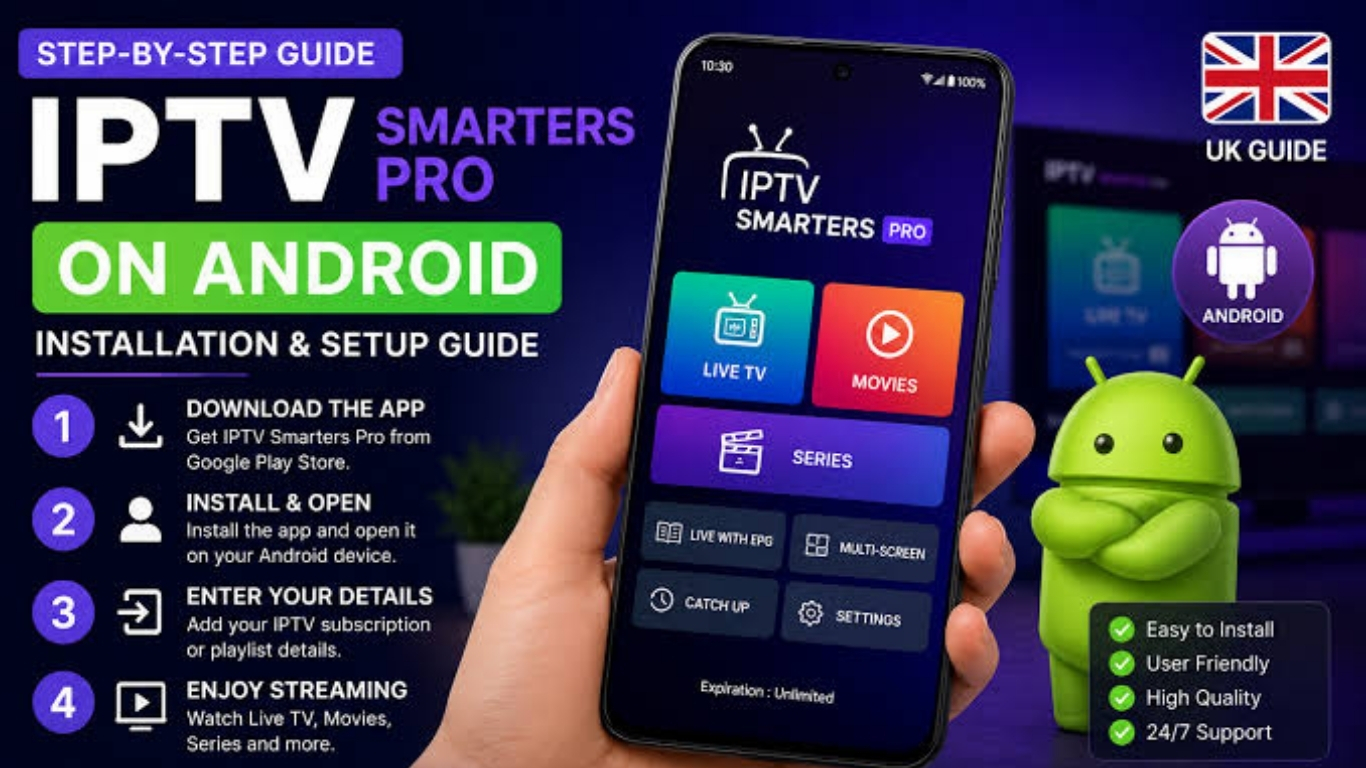
Watching live television, movies, and on-demand content on your smartphone has become a convenient way to enjoy entertainment wherever you are. With an Android smartphone and a compatible IPTV player, you can access your subscribed content without relying on a traditional television.
IPTV UK for Android Smartphones is a useful search topic for anyone looking to understand how IPTV works on Android, what they need to set up, and how to improve streaming performance.
This complete guide explains how to use IPTV on Android smartphones, configure a compatible player, choose the right features, and troubleshoot common problems. Whether you are new to IPTV or already use a streaming application, these tips can help you get started.
What Is IPTV on an Android Smartphone?
IPTV stands for Internet Protocol Television. It delivers television and video content through an internet connection instead of traditional broadcast or cable delivery.
On an Android smartphone, IPTV typically works through a compatible media player or streaming application. The application connects to a legitimate playlist or service account, allowing you to browse and play the content associated with your subscription.
How IPTV Works on Android
The general process looks like this:
- Your Android smartphone connects to the internet.
- You install a compatible IPTV player.
- You enter your authorized playlist or account details.
- The player loads available content.
- You select a channel or video and begin streaming.
The quality of your experience depends on your internet connection, device performance, application compatibility, and the content delivery system.
Benefits of IPTV UK for Android Smartphones
Using IPTV on an Android smartphone offers several practical benefits.
Watch Content on the Go
A smartphone makes it possible to watch supported television and video content while traveling, relaxing at home, or away from your main TV.
You only need a compatible device, an internet connection, and authorized access to the content.
Convenient Viewing
Android smartphones are portable and easy to use. You can watch content without needing a separate television or streaming box.
Flexible Screen Size
Your smartphone allows you to watch in portrait or landscape mode, depending on the application and video.
Landscape mode is often more comfortable for movies and live TV because it provides a wider viewing area.
Access to On-Demand Content
Some IPTV services provide video-on-demand libraries alongside live television. If your subscription includes VOD, you may be able to browse movies and series through your Android player.
Easy App-Based Setup
Most compatible IPTV players are designed to work through a straightforward application interface. Once your subscription details are configured, accessing content can be simple.
How to Set Up IPTV on Android Smartphones
Setting up IPTV on an Android smartphone generally involves installing a compatible player and entering your subscription information.
Step 1: Check Your Android Smartphone
Before installing an IPTV player, make sure your smartphone is functioning properly.
Check:
- Android operating system version
- Available storage space
- Internet connectivity
- Battery level
- Application compatibility
Older smartphones may have limitations with newer applications or high-resolution video.
Step 2: Install a Compatible IPTV Player
Open the official Google Play Store on your Android smartphone.
Search for a compatible IPTV player that supports your subscription format.
Before installing, review:
- App compatibility
- User reviews
- Developer information
- Permissions
- Supported playlist formats
Only install applications from trusted sources.
Why App Compatibility Matters
Not every IPTV player supports the same login methods or playlist formats.
Some players support M3U playlists, while others may support additional authentication methods or electronic program guides.
Choose an application that supports the format supplied with your authorized subscription.
Step 3: Open the IPTV Application
After installation, launch the player.
Depending on the application, you may see options such as:
- Add playlist
- Add user
- Login
- Xtream Codes API
- M3U URL
- Portal URL
The available options depend on the application.
Step 4: Enter Your IPTV Subscription Details
Use the information provided with your legitimate IPTV subscription.
You may need:
- Username
- Password
- Server URL
- M3U playlist URL
- Portal information
Enter the information carefully.
A single incorrect character in a username, password, or URL can prevent the playlist from loading.
Step 5: Save and Load Your Playlist
After entering your details, select the option to save, connect, or load the playlist.
Wait for the application to finish loading.
Depending on the subscription and connection speed, the process may take a short amount of time.
Step 6: Start Watching IPTV on Android
Once your playlist is loaded, browse the available categories.
You may see:
- Live TV
- Movies
- TV series
- Catch-up
- Favorites
- Electronic program guide
The available categories depend on your subscription and the IPTV player.
Select content to begin playback.
Best IPTV Player Features for Android Smartphones
Choosing a suitable IPTV player can make a big difference to your experience.
Instead of focusing only on the application name, look at its features and compatibility.
M3U Playlist Support
If your subscription provides an M3U URL, choose a player that supports it.
Xtream Codes API Support
Some IPTV players support Xtream Codes API login details.
This may allow you to enter a server URL, username, and password instead of manually adding a playlist URL.
Only use login details supplied by your authorized service.
Electronic Program Guide
An electronic program guide, or EPG, displays information about scheduled television programs.
A compatible EPG can make it easier to browse live TV content.
Favorites
A favorites feature allows you to save frequently watched channels or content.
This can be especially useful when a playlist contains many categories.
Catch-Up Support
Some services provide catch-up content.
If your subscription includes catch-up and your player supports it, you may be able to watch previously broadcast programs.
Multiple Playlist Support
Some applications allow users to add more than one playlist.
This feature can be useful if you have multiple authorized content sources.
How to Improve IPTV Streaming on Android
A stable internet connection is essential for smooth IPTV playback.
If your video keeps buffering or freezing, try the following solutions.
Use a Stable Wi-Fi Connection
Wi-Fi is often the most convenient option for Android smartphones.
However, weak signal strength can affect streaming quality.
Try:
- Moving closer to the router
- Reducing the distance between your phone and router
- Connecting to a less congested network
- Restarting your Wi-Fi connection
Use Mobile Data When Necessary
If your Wi-Fi is unstable, mobile data may provide an alternative.
However, streaming video can use a significant amount of data, especially at higher resolutions.
Check your mobile data allowance before watching for long periods.
Monitor Mobile Data Usage
High-quality streaming can consume more data than standard-definition playback.
To manage usage:
- Open Android settings.
- Go to Network & Internet or Connections.
- Open Data Usage.
- Review application usage.
- Set a data warning if needed.
Menu names may vary depending on your Android version.
Choose a Suitable Video Quality
If your
Best IPTV player offers video quality settings, test a lower resolution when buffering occurs.
For example, switching from 4K to Full HD or HD may reduce the bandwidth required.
The best setting depends on your connection and smartphone capabilities.
Close Unnecessary Background Apps
Background applications may use system resources or internet bandwidth.
Before streaming, close unnecessary downloads and applications.
This can help if your phone is running slowly or your connection is busy.
Keep Your Android Smartphone Updated
Check for official Android system updates and application updates.
Updates may improve performance, compatibility, and security.
Always use trusted update sources.
IPTV UK for Android Smartphones: Common Setup Problems
Even when the setup process is straightforward, some users may encounter errors.
Here are common problems and practical solutions.
IPTV Playlist Not Loading
If your playlist does not load, check the following:
- Internet connection
- Playlist URL
- Username
- Password
- Server address
- Subscription status
- Application compatibility
Make sure the information matches the details supplied with your subscription.
IPTV App Keeps Crashing
An application may crash because of insufficient storage, outdated software, or compatibility issues.
Try:
- Closing the application.
- Restarting your smartphone.
- Checking for updates.
- Clearing the app cache.
- Reinstalling the app from a trusted source if needed.
IPTV Buffering on Android
Buffering may be caused by:
- Weak Wi-Fi
- Mobile data congestion
- High video quality
- Network congestion
- Device performance
- Temporary service-side issues
Test your connection and lower video quality if available.
IPTV Audio but No Video
If you hear sound but see no picture, the issue may involve video format compatibility or a playback problem.
Try:
- Restarting the player
- Updating the application
- Testing another supported stream
- Checking whether the video format is supported
IPTV Login Error
A login error may occur if the credentials are incorrect or expired.
Double-check your username, password, and server information.
If the details are correct, contact the subscription service for assistance.
How to Install IPTV on Android TV vs Android Smartphones
Android smartphones and Android TV devices use different interfaces, even though both are based on Android.
| | |
| Main control | Touchscreen | Remote control |
| Screen | Portable display | Television |
| App installation | Google Play Store | TV app store |
| Internet | Wi-Fi or mobile data | Wi-Fi or Ethernet |
| Viewing style | Personal viewing | Larger-screen viewing |
| App compatibility | Smartphone-supported apps | TV-supported apps |
An IPTV player designed for Android TV may not offer the same interface or compatibility on a smartphone.
Always check the application's supported device types.
How to Choose a Reliable IPTV Player for Android
When choosing an IPTV player, consider the following factors.
Compatibility
Make sure the application supports your Android version.
Playlist Support
Check whether it supports your subscription's playlist or login format.
Ease of Use
A clean interface can make it easier to browse channels and content.
Performance
Look for an application that runs smoothly on your device.
Privacy and Security
Review permissions and privacy information before installing.
Avoid applications that request unnecessary access to personal information.
Regular Updates
Applications that receive updates may offer improved compatibility and bug fixes.
IPTV Streaming Tips for Android Users
To get the most from
IPTV UK on your smartphone, follow these simple tips.
Keep Your Device Charged
Streaming video can consume battery power.
Charge your smartphone before long viewing sessions.
Use Headphones When Appropriate
Headphones can improve audio clarity in noisy environments.
Watch in Landscape Mode
Landscape mode may provide a more comfortable viewing experience for movies and live television.
Keep Storage Available
Maintain sufficient free storage for smooth device operation and application updates.
Avoid Untrusted APK Files
Install applications from official or trusted sources.
Unknown APK files may contain security risks.
Use a Strong Password
Protect your IPTV account credentials and avoid sharing them publicly.
Is IPTV Legal on Android Smartphones?
IPTV technology itself is legal. It is simply a method of delivering video content over the internet.
However, the legality of specific content depends on licensing, copyright, and the rights held by the service providing it.
When using IPTV on Android:
- Choose legitimate services.
- Use authorized subscriptions.
- Avoid unauthorized streams.
- Follow applicable copyright laws.
- Review the terms of service.
A media player does not automatically make every available stream legal.
Frequently Asked Questions About IPTV UK for Android Smartphones
Can I watch IPTV on an Android smartphone?
Yes. You can watch IPTV on a compatible Android smartphone using a suitable IPTV player and a legitimate subscription or authorized playlist.
How do I set up IPTV on Android?
Install a compatible IPTV player from the official app store, enter your subscription details, save the playlist, and start watching supported content.
Do I need an IPTV app for Android?
Generally, yes. An IPTV player or compatible streaming application is needed to load and play your IPTV playlist.
Can I use IPTV with mobile data?
Yes, if your player and subscription support it. Streaming may consume significant mobile data, especially at high resolutions.
Why does IPTV buffer on my Android phone?
Buffering can result from weak Wi-Fi, unstable mobile data, high video quality, network congestion, or device performance issues.
How can I reduce IPTV buffering?
Try a stronger internet connection, move closer to your router, reduce video quality when available, and close unnecessary background applications.
Can I watch IPTV in Full HD or 4K on Android?
This depends on your subscription, video source, player, internet connection, and smartphone display capabilities.
Does every IPTV player support M3U playlists?
No. Playlist and login support varies between applications. Check compatibility before installing.
Can I use IPTV on multiple Android devices?
This depends on your subscription terms and the supported device allowance. Check the relevant account details before adding additional devices.
Is IPTV free on Android?
Some IPTV applications are free to install, but access to subscription-based content may require a paid or authorized service.
Conclusion: IPTV UK for Android Smartphones
IPTV UK for Android Smartphones is a useful topic for anyone who wants to understand IPTV setup, streaming, and troubleshooting on a mobile device.
With a compatible Android smartphone, a suitable IPTV player, a stable internet connection, and authorized subscription details, you can enjoy supported live TV and on-demand content from your phone.
The setup process is usually simple: install the player, enter your playlist or login details, load the content, and begin streaming.
For a smoother experience, focus on internet stability, application compatibility, device performance, and safe software installation.
Whether you are a beginner or an experienced IPTV user, these steps can help you make better use of IPTV on your Android smartphone.
Iptv Streaming
Watching television is no longer limited to a single screen in the living room. With modern internet-based television technology, households can access content across televisions, smartphones, tablets, computers, and compatible streaming devices. This has made IPTV on multiple devices in the UK an increasingly relevant topic for families and individuals who want greater flexibility.
However, using IPTV across several devices involves more than simply installing an application on every screen. Factors such as simultaneous connections, bandwidth, device compatibility, network performance, account restrictions, and service terms can affect the overall experience.
This guide explains how multi-device IPTV works, what equipment you need, how many devices you can typically connect, and what UK viewers should consider before setting up IPTV across multiple screens.
What Is IPTV?
IPTV stands for Internet Protocol Television. It refers to delivering television content through IP-based networks rather than traditional terrestrial, satellite, or cable broadcasting.
Depending on the service, IPTV can provide access to live television, video-on-demand content, catch-up programming, electronic programme guides, and other interactive features.
IPTV can be used on various types of devices, including:
- Smart TVs
- Streaming devices
- Smartphones
- Tablets
- Computers
- Compatible set-top boxes
The exact devices supported depend on the application and service.
What Does IPTV on Multiple Devices Mean?
IPTV on multiple devices means accessing an authorized IPTV service or application on more than one compatible screen or device.
For example, a household could potentially have:
- A television in the living room
- Another television in a bedroom
- A smartphone
- A tablet
- A computer
The important distinction is between device registration and simultaneous streaming.
A service may allow several devices to be registered but restrict how many can stream content at the same time.
Device Registration vs Simultaneous Streaming
Device registration refers to adding a device to an account or application.
Simultaneous streaming refers to actively watching content on multiple devices at the same time.
These are not necessarily the same thing.
For example, a service could permit several compatible devices to be associated with an account while allowing only a limited number of active streams simultaneously.
Always check the applicable service terms before using multiple connections.
How Does IPTV Work Across Multiple Devices?
Multi-device
IPTV Setup Guide relies on internet connectivity and compatible software or hardware.
The general process is:
- An IPTV service provides authorized television content.
- The viewer signs in or configures the compatible application.
- The application connects to the relevant servers.
- The selected video is transmitted through an IP network.
- Each compatible device receives and displays its stream.
When several devices stream simultaneously, each active stream consumes network bandwidth.
This means that a household watching high-resolution video on several screens may need significantly more bandwidth than someone watching a single stream.
Which Devices Can Use IPTV in the UK?
The devices available for IPTV depend on the software and service being used.
Smart TVs
Modern Smart TVs can often run compatible streaming applications directly.
Using a Smart TV can eliminate the need for a separate streaming box, provided the television supports the required application.
Streaming Devices
External streaming devices can connect to a television through HDMI and provide access to compatible applications.
They can be useful when a television does not support a particular application or when users want a separate operating environment.
Smartphones
Many IPTV applications can be used on smartphones where supported.
Smartphones provide a convenient way to watch television while travelling or away from the main television screen, subject to the applicable service terms and internet availability.
Tablets
Tablets provide a larger display than smartphones while remaining portable.
They can be useful for viewing television around the home or while travelling.
Computers
Compatible IPTV applications or web-based services may also allow viewing through desktop and laptop computers.
The viewing experience depends on browser, operating system, application, and service compatibility.
How Many IPTV Devices Can You Use?
There is no universal number of devices that applies to every IPTV service.
The permitted number can depend on:
- Account type
- Service terms
- Application
- Subscription conditions
- Device limits
- Simultaneous-stream restrictions
Some services may allow multiple registered devices but limit active streams.
Therefore, users should check the specific terms of the authorized service rather than assuming that every IPTV setup supports unlimited devices.
IPTV Multiple Devices in the UK: Why Bandwidth Matters
Internet bandwidth becomes particularly important when several devices are streaming simultaneously.
Suppose one household has three devices streaming video at the same time. Each stream requires bandwidth, and higher-resolution video generally requires more bandwidth.
A rough example might look like this:
| SD | 3–5 Mbps |
| HD | 5–10 Mbps |
| Full HD | 10–15 Mbps |
| 4K | 20–25 Mbps or more |
These figures are general estimates. Actual bandwidth requirements vary according to compression, bitrate, codec, application, and network conditions.
Multiple 4K Streams
4K video can require considerably more bandwidth than standard-definition or HD video.
A household running several 4K streams simultaneously should have sufficient broadband capacity and a network capable of handling the traffic.
Does IPTV Use More Internet With Multiple Devices?
Yes.
Each active stream generally consumes network bandwidth. If several devices are streaming simultaneously, overall data usage can increase substantially.
For example, a household watching HD video on three devices simultaneously will generally use more bandwidth than a household watching one HD stream.
The exact amount of data consumed depends on:
- Resolution
- Bitrate
- Compression
- Viewing duration
- Number of active streams
- Content type
IPTV Multiple Devices and Wi-Fi
Wi-Fi performance can have a significant impact on multi-device IPTV.
A broadband connection may provide sufficient internet speed, but weak Wi-Fi can still cause problems between the router and individual devices.
Common causes include:
- Distance from the router
- Thick walls
- Wireless interference
- Too many connected devices
- Older Wi-Fi hardware
- Network congestion
Using Ethernet
A wired Ethernet connection can provide a more stable connection for devices such as Smart TVs and streaming boxes.
Ethernet can be particularly useful for devices that regularly stream high-resolution video.
Improving Wi-Fi
If Ethernet is not practical, users can improve wireless performance by:
- Positioning the router in a central location
- Using modern Wi-Fi equipment
- Reducing interference
- Moving devices closer to the router
- Using a suitable mesh Wi-Fi system
- Disconnecting unnecessary devices
IPTV Multi-Device Streaming at Home
A typical UK household may have several people using the internet simultaneously.
One person could be watching television in the living room while another watches content on a tablet and someone else uses a smartphone.
This creates a shared network environment.
Network Capacity
The household's total network usage should be considered rather than looking only at IPTV bandwidth.
Other activities can consume significant bandwidth, including:
- Video calls
- Online gaming
- Large downloads
- Cloud backups
- Software updates
- Other streaming services
A strong broadband connection can help accommodate multiple activities.
IPTV Multiple Devices and Simultaneous Viewing
One of the biggest advantages of multi-device IPTV is the ability to use different screens for different viewing needs, where the authorized service permits simultaneous streaming.
For example, family members may want to watch different programmes on separate devices.
However, simultaneous streaming depends on the service's account rules.
Why Simultaneous Stream Limits Exist
Service operators may impose stream limits for several reasons, including:
- Licensing restrictions
- Account security
- Network capacity
- Subscription terms
- Prevention of account sharing
A user should never assume that registering multiple devices automatically means that all of them can stream simultaneously.
How to Set Up IPTV on Multiple Devices
The setup process varies by application, but the general approach is straightforward.
Step 1: Check Device Compatibility
Confirm that each television, smartphone, tablet, computer, or streaming device supports the required application.
Step 2: Install the Authorized Application
Download the relevant application from an official or trusted source.
Step 3: Sign In or Configure the Account
Use the account credentials or configuration method supplied by the authorized service.
Step 4: Test Each Device
Check playback individually before attempting multiple simultaneous streams.
Step 5: Test Your Network
Run several devices at the same time to determine whether your home network can handle the combined load.
Common Problems With IPTV on Multiple Devices
Multi-device setups can experience several common problems.
Buffering on One Device
If only one device buffers, the problem may be local to that device.
Possible causes include weak Wi-Fi, background downloads, or limited hardware performance.
Buffering on Every Device
If multiple devices buffer simultaneously, the issue may be related to broadband performance, network congestion, or the service itself.
One Device Works, but Another Does Not
This can occur because of differences in:
- Operating systems
- Application versions
- Hardware
- Screen resolution
- Network connection
- Application compatibility
Account Limit Reached
If a service restricts simultaneous connections, attempting to stream on too many devices may result in an error or blocked playback.
Check the service's terms for its permitted number of devices and simultaneous streams.
How to Improve Multi-Device IPTV Performance
Several practical steps can improve performance.
Use a Reliable Broadband Connection
Choose broadband that provides sufficient capacity for the household's overall usage.
Prefer Ethernet for Fixed Devices
Where practical, connect high-use devices such as television boxes directly to the router using Ethernet.
Keep Applications Updated
Updates can improve compatibility, performance, and security.
Restart Network Equipment
Restarting a router can sometimes resolve temporary connectivity problems.
Reduce Unnecessary Network Traffic
Large downloads and other bandwidth-intensive activities can compete with
IPTV streams in UK.
Monitor Connected Devices
Check which devices are using the network and disconnect devices that are no longer needed.
IPTV Multiple Devices and Data Usage
Data consumption is another consideration for UK households.
Streaming continuously for several hours across multiple devices can consume a substantial amount of data.
However, many modern broadband packages provide high or unlimited data allowances.
Users should still understand their broadband package, particularly if they have a limited data allowance.
Factors Affecting Data Consumption
Data usage varies according to:
- Video resolution
- Bitrate
- Compression
- Streaming duration
- Number of devices
Higher-resolution video generally consumes more data.
Can IPTV Work on Multiple TVs?
Yes, IPTV can potentially be used on multiple televisions if the relevant service, applications, and account terms support it.
Each television may require:
- A compatible Smart TV application
- A compatible streaming device
- An IPTV set-top box
- Appropriate network connectivity
The number of televisions that can actively stream at the same time depends on the service's conditions.
IPTV Multiple Devices for Families
Multi-device IPTV can be particularly useful in households where family members have different viewing preferences.
One person may prefer live television on a main TV while another uses a tablet or smartphone.
However, families should consider:
- Number of household users
- Number of screens
- Simultaneous streaming limits
- Broadband capacity
- Wi-Fi coverage
- Device compatibility
A household with several active users may need a stronger home network than a single-person household.
IPTV Multiple Devices While Travelling
Some authorized IPTV services may support mobile viewing outside the home.
This can provide flexibility for users who want to watch content on smartphones, tablets, or laptops while travelling.
However, availability can depend on:
- Service terms
- Geographic restrictions
- Internet connectivity
- Device compatibility
- Content licensing
Users should review the applicable terms before using a service outside their normal location.
IPTV Multiple Devices and Account Security
Using
IPTV UK across multiple devices means that account security becomes increasingly important.
Users should:
- Use strong passwords.
- Avoid sharing credentials unnecessarily.
- Enable additional security features where available.
- Keep applications updated.
- Download software from trusted sources.
- Sign out of devices that are no longer used.
These basic practices can reduce the risk of unauthorized account access.
Legal Considerations for IPTV in the UK
IPTV is a legitimate technology used to deliver television through IP networks.
The important issue is whether the service providing the content has the appropriate rights and permissions to distribute it.
UK viewers should use authorized services and comply with applicable copyright laws and service terms.
The fact that a device or application supports IPTV does not automatically determine whether the content being accessed is authorized.
IPTV Multiple Devices vs Traditional Television
Multi-device IPTV provides flexibility that traditional television setups may not always offer.
| Multiple screens | Often supported | Depends on equipment |
| Smartphone viewing | Often available | May require additional service |
| Tablet viewing | Often available | May require additional service |
| Internet required | Usually | Not always |
| Simultaneous viewing | Depends on service | Depends on subscription/equipment |
| On-demand content | Often available | Depends on service |
| Electronic programme guide | Often available | Common with digital systems |
The exact features vary significantly between services and technologies.
What to Consider Before Using IPTV on Multiple Devices
Before setting up a multi-device IPTV environment, consider the following:
Device Compatibility
Make sure every intended device supports the required application or platform.
Simultaneous Stream Limits
Check how many devices can actively stream at the same time.
Broadband Speed
Ensure your internet connection can handle the combined demand.
Wi-Fi Coverage
Make sure all televisions and mobile devices receive a reliable connection.
Data Allowance
Check whether your broadband package has any data limits.
Security
Protect your account and network using appropriate security practices.
Content Authorization
Use legitimate services with appropriate rights to distribute their programming.
Frequently Asked Questions
Can IPTV be used on multiple devices in the UK?
Yes. IPTV can be used on multiple compatible devices where the relevant service and account terms permit it.
How many devices can use IPTV at once?
There is no universal limit. The number depends on the service's device and simultaneous-stream policies.
Can I use IPTV on two TVs at the same time?
This may be possible if the authorized service permits multiple simultaneous streams and both televisions are compatible.
Does using IPTV on multiple devices require faster internet?
Generally, yes. Multiple simultaneous streams require more combined bandwidth than a single stream.
Can IPTV work on a Smart TV and smartphone simultaneously?
Potentially, yes, provided the application supports both devices and the account allows simultaneous viewing.
Does IPTV use a lot of data?
It can. Data usage increases with higher video quality, longer viewing sessions, and additional simultaneous streams.
Is Ethernet better than Wi-Fi for IPTV?
Ethernet can provide a more stable connection for fixed devices, particularly when streaming high-resolution video.
Can IPTV be used outside the home?
Some authorized services support mobile or remote viewing, but this depends on their terms, geographic restrictions, and device compatibility.
Is multi-device IPTV legal in the UK?
Multi-device IPTV itself is not illegal. Users should ensure that the service they use is authorized to distribute the content they provide.
Conclusion
IPTV in UK setups can provide households with a flexible way to access television across Smart TVs, streaming devices, smartphones, tablets, and computers.
The most important factors are not simply the number of devices you own. You also need to consider simultaneous-stream limits, broadband capacity, Wi-Fi performance, device compatibility, data usage, account security, and content authorization.
A reliable multi-device setup starts with a suitable home network and compatible equipment. Testing each device individually and then testing them together can help identify potential performance issues before they become frustrating.
For UK viewers, IPTV can be a convenient technology for multi-screen entertainment when used with authorized content and a service that supports the number of devices and simultaneous streams required by the household.
Iptv Streaming
What Is IPTV UK with 4K Streaming Support?
IPTV UK with 4K streaming support refers to Internet Protocol Television services that deliver television channels and on-demand content over an internet connection while supporting Ultra HD (4K) video quality. Unlike traditional satellite or cable TV, IPTV streams content directly through broadband, offering greater flexibility and access across multiple devices.
As internet speeds continue to improve across the UK, more households are choosing IPTV because it provides high-resolution streaming, smart features, and convenient viewing options. When combined with 4K technology, IPTV delivers sharper images, richer colours, and smoother motion for a premium entertainment experience.
Whether you enjoy sports, films, documentaries, or television series, a 4K-compatible IPTV setup can significantly improve picture quality when supported by compatible hardware and a stable internet connection.
Why 4K Streaming Is Becoming the New Standard
Television technology has evolved rapidly over the past decade. Full HD was once considered the highest available resolution, but 4K has now become the preferred option for many viewers.
A 4K display contains approximately four times as many pixels as a Full HD screen, resulting in:
- Sharper image quality
- Better detail in dark scenes
- More realistic colours
- Improved viewing on larger televisions
- Enhanced sports and action scenes
As more content becomes available in Ultra HD, IPTV services capable of delivering 4K streams are becoming increasingly popular throughout the UK.
How IPTV Works
IPTV delivers television content using Internet protocols rather than traditional broadcasting methods.
Instead of receiving signals through satellite dishes or cable networks, users stream content through broadband internet.
A typical IPTV setup includes:
- Stable internet connection
- Smart TV
- Streaming device
- IPTV-compatible application
- Subscription from a legitimate IPTV service
The content is delivered in real time or made available as video-on-demand, depending on the service features.
Benefits of IPTV UK with 4K Streaming Support
Choosing 4K IPTV UK capability offers several advantages beyond improved picture quality.
Superior Video Quality
Ultra HD provides exceptional clarity that makes films, documentaries, and sporting events more immersive.
Viewers notice:
- Fine textures
- Better contrast
- Crisp details
- Smooth motion
- Reduced image distortion
Flexible Viewing
Modern IPTV allows users to watch content across multiple devices.
Popular supported devices include:
- Smart TVs
- Android TV
- Google TV
- Fire TV devices
- Android phones
- Tablets
- Windows PCs
- Mac computers
Many platforms also allow users to continue watching from different devices.
Extensive Content Libraries
Many IPTV platforms include:
- Live television
- Movies
- TV series
- Sports
- Children's programming
- International channels
- Documentary collections
Having everything accessible from one interface improves convenience for viewers.
On-Demand Entertainment
Rather than waiting for scheduled broadcasts, viewers can access on-demand libraries whenever they choose.
This flexibility allows users to enjoy entertainment according to their own schedule.
Internet Requirements for Smooth 4K IPTV Streaming
Streaming 4K content requires significantly more bandwidth than HD streaming.
Recommended internet speeds include:
Higher speeds provide greater stability, particularly when multiple devices share the same network.
Using Ethernet instead of Wi-Fi can also improve streaming consistency.
Best Devices for IPTV 4K Streaming
Selecting compatible hardware is just as important as choosing a quality IPTV service.
Recommended device categories include:
Smart TVs
Modern smart televisions often include built-in IPTV applications or support downloading compatible apps.
Android TV Boxes
Android TV devices offer flexible installation options and support various IPTV applications.
Streaming Devices
Dedicated streaming devices often provide:
- Fast processors
- Better app compatibility
- Voice control
- 4K HDR support
- Automatic updates
Computers
Windows and macOS systems can also stream IPTV using compatible applications or browser-based platforms.
Smartphones and Tablets
Mobile devices provide convenient access while travelling or away from home.
Features to Look for in IPTV UK with 4K Streaming Support
Not all IPTV services provide the same viewing experience.
When comparing services, consider features such as:
4K Compatibility
Ensure the platform genuinely supports Ultra HD streaming rather than simply offering HD content.
Stable Servers
Reliable infrastructure reduces:
- Buffering
- Freezing
- Playback interruptions
Electronic Program Guide
An integrated programme guide makes navigation much easier.
Catch-Up TV
Catch-up features allow viewers to watch recently aired programmes.
Video on Demand
Extensive movie and television libraries increase entertainment options.
Multi-Device Support
Access across multiple compatible devices provides greater flexibility.
Regular Updates
Frequently updated content libraries improve long-term value.
Common Causes of Buffering
Buffering remains one of the most common IPTV issues.
Potential causes include:
- Slow internet
- Wi-Fi interference
- Device limitations
- Network congestion
- Outdated applications
- Overloaded servers
Improving home networking often resolves many playback issues.
Stay informed about UK copyright regulations by visiting GOV.UK: https://www.gov.uk/copyright.
Tips for Achieving the Best 4K Streaming Experience
For optimal viewing:
- Use wired Ethernet whenever possible.
- Restart networking equipment regularly.
- Keep streaming applications updated.
- Use modern streaming hardware.
- Close unnecessary background applications.
- Ensure sufficient internet bandwidth.
- Position Wi-Fi routers centrally if using wireless connections.
These simple practices can noticeably improve streaming performance.
Is IPTV Legal in the UK?
IPTV technology itself is legal. Many broadcasters and media companies use IPTV to deliver television services over the internet.
However, legality depends on whether a service has the appropriate rights and licences to distribute the content it offers. Users should choose legitimate services that operate within applicable copyright laws and licensing agreements.
Learn the legality of IPTV in the UK before choosing any streaming service.
4K vs HD Streaming
While HD still provides excellent quality, 4K offers a noticeably more detailed viewing experience, particularly on larger televisions.
Common IPTV Myths
IPTV Always Buffers
Buffering is usually related to internet quality, network conditions, or service reliability—not IPTV technology itself.
4K Works on Every TV
A television must support 4K resolution to display Ultra HD content properly.
Faster Internet Always Solves Everything
While bandwidth is important, router quality, device performance, and network stability also affect streaming quality.
Future of IPTV in the UK
The IPTV market continues to evolve with advancements in streaming technology, internet infrastructure, and consumer demand.
Emerging trends include:
- Wider availability of Ultra HD content
- Improved video compression
- Enhanced user interfaces
- AI-powered content recommendations
- Greater cloud integration
- Expanded multi-device synchronisation
As fibre broadband becomes more widely available, 4K IPTV streaming is expected to become increasingly accessible across the UK.
Frequently Asked Questions
What is IPTV UK with 4K streaming support?
It is an internet-based television service capable of delivering compatible live and on-demand content in Ultra HD (4K) resolution over a suitable broadband connection.
What internet speed is recommended for 4K IPTV?
A stable connection of at least 30–50 Mbps is generally recommended for smooth 4K streaming, especially if multiple devices are connected.
Can I watch IPTV on a Smart TV?
Yes. Many Smart TVs support IPTV applications or browser-based streaming platforms.
Does every programme stream in 4K?
No. Availability depends on whether the content provider offers that specific programme in 4K and whether your device supports Ultra HD playback.
Is Ethernet better than Wi-Fi for IPTV?
Yes. A wired Ethernet connection typically provides greater stability, lower latency, and fewer interruptions than Wi-Fi.
Can multiple devices use IPTV simultaneously?
Many services support multiple devices, although the number of simultaneous streams depends on the subscription and platform.
Conclusion
IPTV UK with 4K streaming support combines the flexibility of internet-based television with the outstanding visual quality of Ultra HD. With the right combination of a reliable internet connection, compatible hardware, and a legitimate IPTV service, viewers can enjoy crisp images, vibrant colours, and a modern viewing experience across a variety of devices.
Before choosing a service, consider factors such as 4K compatibility, device support, streaming stability, content availability, and legal compliance. Taking the time to evaluate these aspects will help ensure a reliable and enjoyable entertainment experience that meets your viewing preferences both now and in the future.